


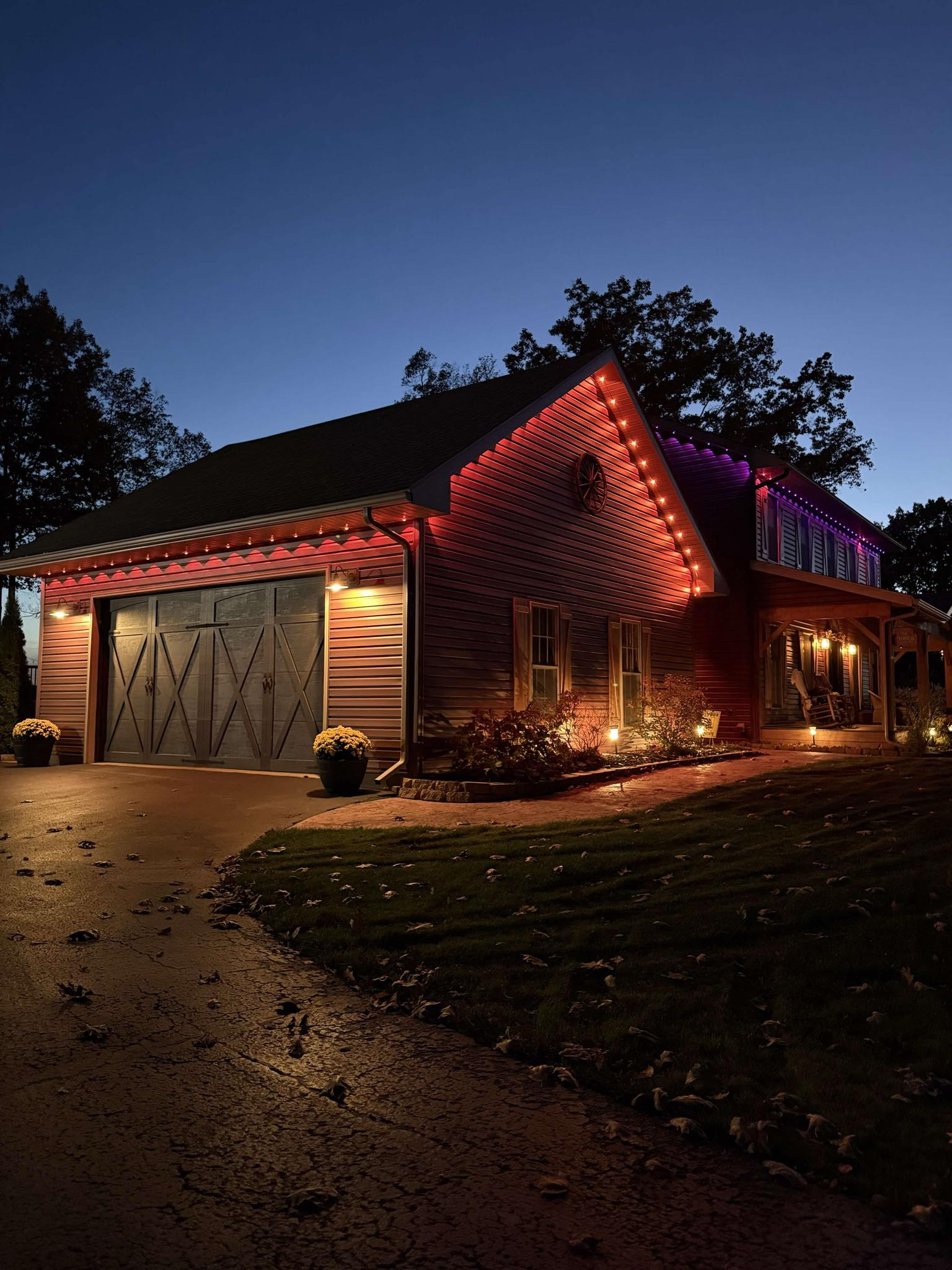


For those who would rather not continue doing second-floor eave lighting annually, the permanent roof line lights are more appropriate for a two-story house that needs annual lighting. For someone interested in Christmas lighting, who loves C9 bulbs, and can reach the second floor without any problems, then string lighting is more appropriate. The Govee Permanent Outdoor Lights 2 Pro has an IP68 (dustproof and waterproof) lamp body, is cuttable, has app and Matter (smart home cross-platform standard) capability; however, it is a first-time project and maintenance might also require additional climbing. Which Is Better for a Two-Story House, Permanent or Temporary Lights It comes down to two key questions when choosing lighting for a two-story house: how often will you install the lights, and who will climb to the second floor later? The table below applies to both options. For a two-story house Permanent roofline lights Temporary Christmas string lights Ladder work at the upper eaves One initial installation project, done by you or a hired pro; inspection or repair may still require access At least two work sessions every season (installation and removal), with multiple climbs or ladder moves possible in each Changing the look for another holiday Pick colors and scenes in the app from the ground Rehang the lights; a single-color or theme-specific set may need to be replaced, while color-changing temporary sets can be reused Work every year No routine hanging, taking down, or storing; inspect and maintain as needed Test, hang, take down, untangle, and store Upfront cost Higher upfront cost Lower to start Classic Christmas look Lights stay mounted under the eaves; not large C9 bulbs Large C9 or C7 bulbs are easy to get Use beyond December Holidays plus everyday lighting Can cover other occasions if the colors and design fit, but the set still has to be hung and removed What to check before buying Waterproof rating, warm white range, warranty, where the power adapter plugs in A safety-tested label for outdoor use, outlet, and cord route And here is how it works in reality: - If you want to get the lights each year and you are going to use them as everyday lights, then permanent lights will be the best year-round lights for your home. - But if you need lights only for the Christmas period, you enjoy C9 bulbs and you can install them safely up to the second floor, then temporary string lights will suit you more, like, for example, Govee C9 Christmas String Lights. - But if you need both, then permanent lights must be installed on front eaves, and the other on the trees and porches. When selecting temporary string lights, it is necessary to look at safety and outdoors test marks on the package. How Much Ladder Work Each Option Takes on a Two-Story Roofline In the case of a two-story house, even though the installation of string lights requires only two times climbing up and down the ladder per year, once for installation and once for removal, it can involve climbing multiple times in case the string lights need replacement. Falls are the chief risk. According to the U.S. Consumer Product Safety Commission, falls cause nearly half of all holiday decorating accidents. Three basic ladder rules, adapted from the OSHA ladder rules (which are workplace guidelines, not a homeowner requirement): Place the bottom of the ladder approximately one quarter of its working length from the wall. On ladders with extension to an upper landing surface, the side rails shall extend at least 3 feet above such surfaces. For those situations where you or the ladder might come in contact with energized electrical wiring and components, make sure that the ladder is made of non-conducting materials. Moreover, you should also ensure that there is someone holding the ladder from the ground level for as long as you are using it. The installation of permanent rooflights alters the calculations regarding ladders. You or the professional installs it once, and then after that, modifications in the festive lighting effects can be done through an application from the ground level. Hanging and Taking Down String Lights Every Year vs a One-Time Permanent Install But temporary lights mean the annual cycle starts again: checking to make sure the strings work and replacing any blown bulbs, getting them up with a ladder around the corners and downspouts, taking it all down at the end of the season and packing it away. If you choose this option, read our advice on how to hang Christmas lights on gutters. The permanent holiday lights mean no annual cycle and only setup once, plus checking and maintenance. In order for you to have an estimate of your trade-off, you can just compute the sum of your time spent installing and removing the lights from the previous year and then multiply that by the number of years you expect to live in your house. What Each Option Costs Over the Years You Stay The cost comparison between permanent and temporary Christmas lights does not depend on the first year. It depends on how long you will stay. Use these three steps: 1. Add up the total initial costs for the permanent system: cost of the set on the date of purchase plus cost of its installation if you are hiring the installation services. 2. Account for annual recurring costs of both options individually: inspection and maintenance costs for the permanent lights and costs of replacing the strands/clips or costs of annual installation/removal for the temporary lights. 3. Calculate approximate break-even: (permanent initial cost - temporary first purchase cost) ÷ (temporary annual recurring cost - permanent annual recurring cost). If the denominator is zero or negative, there is no break-even point. For instance, if a group gives you a quote of $600 per season with no costs of light installation included, the same professionally installed light system will break even in the seventh season of your use if its price is $4,000. The example is purely hypothetical and considers the initial cost of lights as zero. If you have someone installing the lights for you each season, you will have the payback period shortened. If you install the lights yourself, meaning that you do not have a height phobia, you will spend less money on temporary lights per season. For the difference between DIY and professional installation costs, see how much permanent Christmas lights cost. If you are still weighing the purchase, read whether permanent lights are worth it. DIY or Hire a Pro for Second-Story Eaves Option Who climbs to the second story How often Trade-off DIY permanent roofline lights You One initial installation project; multiple climbs or ladder moves may be needed You plan runs and power yourself; later inspection or repair may still require access Professionally installed permanent lights A hired installer Initial installation, then service only as needed Higher upfront cost; no ladder work for routine color changes DIY temporary string lights You At least two work sessions every season—installation and removal Lowest upfront cost; each session may require multiple climbs or ladder moves Hired seasonal installation A hired crew Installation and removal every season No climbing for you; you pay for recurring seasonal service For two-story homes, Christmas lights outdoor installation using a DIY permanent kit is a first-time project that takes real effort; and it will take more than one climb. In case you do not want to climb, a professional can do the job of permanent lights installation for you. After that, changing color and scenes will be done without the use of any ladder but you might still have to climb once in case you are inspecting your lights. Professional seasonal installation is something you will pay for every season. Permanent lights installed in the front eaves, while seasonal lights installed on the trees and porches, is quite a common combination for outdoor Christmas lights for house. Whichever route you choose, always follow the product manual and local electrical codes. For hardwired installations, hire a licensed electrician. Govee Permanent Roofline Lights for Two-Story Homes Both Govee permanent outdoor lights below can be cut and extended, support Matter, Alexa, and Google Assistant, and carry a 3-year warranty. They differ in eave shape, length, and budget. Govee Permanent Outdoor Lights 2 Pro: Best for Two-Story Rooflines With Split Runs The Govee Permanent Outdoor Lights 2 Pro is better suited for two-story homes whose rooflines need separately controlled runs, such as separate upper and lower eaves. The difference: two-story eaves have corners, gables, and an upper/lower distinction. In both products, it is possible to splice them around corners, but the 2 Pro also comes with a Y connector allowing for splitting the run and controlling the lights separately. After you install upper and lower eaves, you will be able to change holiday scenes (Christmas/Halloween, for instance) and pure white light from the ground using the app. To splice them, follow the instructions included in the package for your product. The lamp body and Y connector have an IP68 rating, and the control box/adapter has IP67. Spec Govee Permanent Outdoor Lights 2 Pro Lengths 100ft (H3A51), 200ft (H3A53) Lights and brightness, 100ft 42 lights, 55lm per light Lights and brightness, 200ft 84 lights, 40lm per light Waterproof rating String lights IP68, control box IP67, power adapter IP67 Operating temperature -22°F to 140°F White color temperature 1000K–10000K Price, 100ft $499.99 Price, 200ft $799.99 Advantages The splits of the Y connector are suitable for multiple eave segments. IP68 rated lamp body and Y connector, IP67 control box and adapter, works at -22°F to 140°F (18°F colder at the low end compared to the Pro's -4°F). 1000K–10000K white light; compatible with Matter, Alexa, Google Assistant, and Apple Watch. Disadvantages Higher base cost at 100 feet ($499.99 compared to $479.99 of the Pro) and only available in 100 and 200 feet, with no 150 feet option. At 200 feet, the 2 Pro is currently selling at $639.99 (was $799.99), whereas the Pro is at $759.99 (October 23, 2026). Light count and brightness vary by length: 42 lights at 55lm for the 100ft version (brighter than the Pro’s 50lm per light) and 84 lights at 40lm for the 200ft version (dimmer than the Pro). Best for: two-story house with upper and lower eave segments to be controlled separately as zones. Govee Permanent Outdoor Lights Pro: Best for 100–150-Foot Runs on a Tighter Budget The Govee Permanent Outdoor Lights Pro is better suited for a measured 100- to 150-foot run, a lower kit price, and layouts that do not need the 2 Pro's independently controlled Y-connector branches. The breakdown: A 50ft or 100ft unit could work fine for a small home, a bungalow, or a two-story home. This is only an approximation; therefore, we advise that you measure the length of your roof line first before purchasing the kit from the measurements. The Pro series is available in 100ft, 150ft, and 200ft lengths. It is extendable up to a maximum of 200ft, and anything above 150ft needs a Govee driver module that comes with the 200ft kit. It produces a white light with a color temperature of 2,700K to 6,500K, having 50 lumens per light (60 lights at 100ft, 120 lights at 200ft). Operating temperature ranges from -4°F to 140°F. For those who prefer not to go up to the second floor themselves, the official website recommends hiring a professional for installation. Spec Govee Permanent Outdoor Lights Pro Lengths 100ft (H706A), 150ft (H706B), 200ft (H706C) Lights, 100ft 60 lights Lights, 200ft 120 lights Brightness 50 lumens per light Waterproof rating String lights IP67, control box IP65; adapter for indoor use only Operating temperature -4°F to 140°F White color temperature 2,700K–6,500K Price, 100ft $439.99 Price, 150ft $599.99 Price, 200ft $759.99 Advantages Multiple sizes and a cheaper initial price: $439.99 (100ft), $599.99 (150ft), $759.99 (200ft), as of October 22, 2026. More lights in the same length: 60 at 100ft compared to 42 at 2 Pro. Disadvantages The adapter is indoor-only, so take into consideration the placement of your power supply and wiring in accordance with the manual. The lamp housing is rated IP67, while the control box is IP65 – which is a lower rating compared to the 2 Pro's. Best for: a two-storey house with an estimated eave length of 100-150ft, without the need for independent branch control, and a smaller budget. Being two-story does not necessarily mean 100ft. Can permanent roofline lights stay up through winter? Yes, as long as every component (lamp body, control box, and adapter) meets the manufacturer’s water-resistance rating and operating temperature range for your conditions, so don’t rely on the lamp body’s IP number alone. The 2 Pro has IP68 lamp body, IP67 adapter, and works in range from -22°F to 140°F. The Pro has IP67 lamp body, operates in range from -4°F to 140°F, and indoor adapter only. IP numbers are classified in accordance with IEC 60529 standard. Conclusion For a two-story house, start by figuring out how often you will climb to the second floor over the next few years. The installation of permanent lights makes the annual cycle of hanging and removing lights unnecessary. In conclusion: if you want to control the top and bottom parts of the eave separately, choose the 2 Pro model. In case you have an accurately calculated run of 100 to 150 feet and a little less money, choose the Pro model. In case you want to use Christmas lights with C9 bulbs only, choose temporary string lights. First, measure your eaves, and then go to the Govee website to find the required length.
10/29/2026
If you don’t have an outlet in your yard and you anticipate a string of cloudy days, Govee Outdoor Solar String Lights are a better option than solar-only strings, since their USB-C input lets you recharge the battery indoors rather than waiting for the sun. It is powered by a 6W solar panel and a 4800mAh battery that provides up to 13 hours of light at 10 lm. Those numbers matter because solar lights fail in two ways: they’re judged by maximum runtime without checking brightness, and they’re bought with no way to recharge. This article will explain what to buy, why the outdoor holiday lights become less bright after several rainy days, how long a full charge lasts, how to place the solar panel, the difference between solar, battery, and plug-in lights, and who the Govee option suits. What to Look for in Solar Christmas Lights for a Yard With No Outlet The duration that your lights remain lit depends on three factors if there is no external source – the capacity of the batteries, the level of brightness, and your ability to recharge the batteries even when the weather is uncooperative. The following seven points should be used to rate any set of lights against the three factors mentioned above. Look for solar Christmas lights where you can lower brightness and use USB-C backup. This will allow you to get the most out of each charge and top up on power when needed. What to check Why it matters after cloudy days What to look for Govee solar string lights Battery capacity Stored energy is all you have on gray days A published mAh rating 4800mAh Solar panel A bigger, movable panel refills faster on short winter days Stated wattage and a panel you can aim 6W, detachable, 180° adjustable Runtime at a stated brightness Runtime claims depend on the brightness used in testing Hours listed for both low and high brightness Up to 13 hours at 10 lm; 4 hours at maximum brightness (50 lm per bulb) Backup charging Lets you refill the battery when the sun doesn’t USB-C input USB-C charging indoors (the solar module detaches from the string); no USB-C cable or adapter listed in the box Dimming and schedule Lower output and shorter hours stretch each charge App or remote dimming, timer, dusk sensor App dimming, scheduled on/off, light-sensing automation, real-time battery status Weather rating Lights stay outside through rain and snow Match the tested ingress condition to the installation IP67 (dust-tight and protected against temporary immersion in water) string lights and solar panel Coverage Decides how much of the yard one set can light Length and bulb count 33 ft, 8 bulbs, 4.92 ft apart A weather rating only helps if it fits how you install the lights, and the ANSI/NEMA IP rating table lays out what each IP number actually tests. If you want to look beyond solar, you can also browse outdoor string lights with other power options. Why Solar Holiday Lights Dim After Cloudy Days Nightly operation of solar lights takes place with energy accumulated throughout the day, hence the importance of the battery when the sun goes down. If the skies turn gray, then the battery will receive insufficient charge. It has been stated by the U.S. Department of Energy that heavy clouds can deprive a solar panel from almost all rays of the Sun, thus leaving only diffuse radiation for charging. Winter time provides another difficulty due to fewer hours of daylight as well as to the lower position of the Sun, resulting in greater inclination of its rays against the panel. If we combine both factors, then just a few days of gray weather in winter may discharge the battery before it could be replenished. Lights are not damaged; it is simply that they run out of charge sooner. How Many Nights Solar Christmas Lights Last Through Five or More Cloudy Days The longest runtime on a package is often measured at low brightness. A better check takes three steps. 1. Pick how many hours you want the lights on each night. This example uses 4 hours. 2. Divide the runtime at your brightness by those hours. A full charge on the Govee solar string lights gives up to 13 hours at 10 lm, so 13 ÷ 4 gives 3 complete 4-hour nights. At maximum brightness (50 lm per bulb), a full charge gives 4 hours, or 1 night. 3. Multiply by the cloudy nights ahead. Five nights × 4 hours is 20 hours, which is more than one full charge at 10 lm (up to 13 hours), so plan on a USB-C top-up. Nightly schedule Hours needed for 5 cloudy nights Full charges needed at 10 lm (up to 13 hours each) 4 hours a night 20 hours 2 6 hours a night 30 hours 3 The table assumes up to 13 hours of performance at 10 lm based on the figure on the product page under the standard amount of sunlight. The above number is valid only for 10 lm. If the brightness setting is higher, then the duration of each charge will be shorter, meaning you will have to recharge more often. Actual runtime also varies with sun exposure, and cloudy days and low temperatures can shorten it further, because the battery takes on less charge. During five or more cloudy days, plan on at least one USB-C recharge. Then make sure each charge lasts as long as possible. In the app, reduce the brightness setting – according to the product page, 10%–30% brightness is enough to provide ambient lighting and increase runtime. Set the lights to turn off after the needed time period and activate the automatic switch-on mode due to light sensors to turn on the lights during dusk. If you want a walkthrough, here is how to set a Govee timer. Where to Put the Solar Panel When Winter Days Are Short Install the solar panel in the most open area in your yard, without any tree shadows, house eave shadows, or fence shadows. String does not need to be in the sun, because only the panel should catch sunlight. Govee solar panel can be disconnected from the string and turned by 180° angle, allowing aiming it at the sun, while the lighting decorates fence or porch rail in the shadow. Be sure that your panel is not covered with anything. Besides that, if the solar panel is dirty, then it will not be able to charge effectively, so clean it regularly. If you experience cold weather, there is one more thing that you have to do. The Govee lights operate from -4°F to 113°F, but the battery only charges between 32°F and 122°F. On freezing days, charge the solar module indoors over USB-C. This lines up with general battery guidance that lithium-ion batteries should not charge below freezing. Solar vs Battery vs Plug-In Christmas Lights for a Yard Without an Outlet With no outlet, your realistic options are solar and battery-powered lights. Plug-in LED string lights are steadier, but they need an outdoor outlet first. Option Works with no outlet? What happens in a cloudy week Trade-off Solar-only string lights Yes Dim or shut off early once stored energy runs out No way to refill without sun Solar lights with USB-C backup Yes Recharge indoors over USB-C and keep going You need to bring the panel or battery in to charge Battery-operated (AA) holiday lights Yes Runtime does not depend on sun Disposable batteries to replace through the season Plug-in LED string lights No, needs an outdoor outlet Weather does not matter Needs a covered, weatherproof GFCI outlet and a cord run If you can install an outlet and you want lights that stay bright all night, then the Govee Outdoor Clear Bulb String Lights should be your go-to option. These lights must connect to a Class A GFCI outlet with a weatherproof enclosure. This means they are not a choice for a yard that does not have an outlet right now. LED holiday lights use less energy than incandescent strings according to ENERGY STAR. This article does not compare how much power each type uses. For any setup make sure the lights and extension cords are marked for outdoor use as the Electrical Safety Foundation International advises. Always follow the safety instructions in the product manual. Govee Outdoor Solar String Lights for a Small No-Outlet Display After the first setup, the lights take care of themselves from dusk onward. A typical night looks like this: 1. The 6W solar panel charges the battery during the day. 2. The lights switch on automatically after dark. 3. You can dim them in the app and set them to turn off after 4 hours. Before a long cloudy stretch, check the real-time battery status, then detach the solar module and take it inside to recharge over USB-C. You will need to supply your own USB-C cable and charger, since neither is in the box. Pros In the rainy days, USB-C backup lets you refill the battery instead of waiting for clear skies. The product page lists up to 13 hours at 10 lm and 4 hours at maximum brightness (50 lm per bulb). The string lights and solar panel are IP67, the board detaches and adjusts, and the app shows real-time battery status. Cons and limits With 8 bulbs across 33 ft, spaced 4.92 ft apart, the set suits small-area accents, not dense wraps on shrubs and trees. For a whole row of shrubs or a full roofline, see more Christmas lights. App control is Bluetooth only, with no Wi-Fi or voice assistant support. At maximum brightness the runtime is about 4 hours. The battery will not charge below 32°F, so charge the solar module indoors over USB-C on freezing days. Who it fits: Buyers who are happy with a small accent display and who already own a USB-C cable and charger. It is not the right pick if you want a full roofline, voice or Wi-Fi control, or lights that stay at maximum brightness all night. The lights have RGBICW (red, green, blue and warm white LEDs with individually controlled color segments) for color, with 16 million colors and a white light mode, so you can choose red, green or warm white. The original price of Govee Solar String Lights is $99.99. FAQ about Solar Christmas Lights for No-Outlet Yards Do solar Christmas lights work in winter? Yes, but runtime is shorter because short days and low temperatures mean less sunlight and a slower recharge. The Govee solar string lights operate from -4°F to 113°F, but the battery only charges between 32°F and 122°F. On freezing days, take the solar module indoors and charge it over USB-C. Do solar holiday lights charge on cloudy days? Yes, but very slowly because thick clouds block most direct sunlight, so the panel is able to collect only a little scattered light. While heavy clouds reduce solar generation to a fraction of its capacity through scattered light, combining stored battery power, a USB-C top-up, and smart energy-saving habits like dimming can help keep your lights running through a cloudy stretch. Can I charge solar Christmas lights over USB-C instead of sunlight? Yes, on models that have a USB-C input, so check for one before purchase. The Govee solar module detaches from the string and can be brought indoors to recharge via USB-C. There is no mention of a USB-C cable or power adapter in the box so you will need to bring your own. Does lowering the brightness make solar lights last longer? Yes. The Govee solar string lights can last up to 13 hours at 10 lm, but only 4 hours at maximum brightness (50 lm per bulb). The brighter you run them, the sooner the battery empties, so you will need more top-ups or a shorter nightly schedule. Can solar Christmas lights stay outside in rain and snow? Yes, if they have a suitable IP rating. Govee lists the rating for both the string lights and the solar panel as IP67 (dust-tight and protected against temporary immersion in water). Ensure any lights you pick are rated for outdoor use and read more about the IP67 waterproof rating. Conclusion If you don’t have an outlet in your yard, you can judge solar lights by one question: How many nightswill one full charge last at the brightness you will actually use, and how will you cover the rest? Dim first. If you have a small display without an outlet, such as a section of fence, patio edge or porch, the Govee Outdoor Solar String Lights fit that approach. For full specs, click the product page. Check the FAQ section above for common questions.
10/29/2026
Permanent outdoor lights are the new trend in the market that save you from the hassle of buying seasonal lights every time a season changes as these can remain outside our door year-round. This guide explores what they are, how they work, their worth, and more to help you understand everything before you invest in them. Part 1. What are Permanent Outdoor Lights? Permanent outdoor lights are fixed lighting system that remain year-round at your house’s exterior, so you don’t have to set up seasonal lights every year. With mobile app and smart compatibility, it gives you full control over color, brightness, and lighting effects at an instant. Because they remain outside of your house, they have the capability to withstand the different weather changes. Most common place to put them is along rooflines to promote safety and beautification. Part 2. Are Permanent Outdoor Lights Worth it? Yes, definitely. Permanent outdoor lights can be worth it if you want year-round lighting without reinstalling seasonal lights. They combine home security, holiday decoration, and everyday outdoor ambiance in one system. For families that decorate for Christmas, Halloween, and other holidays, permanent lights eliminate the need to climb ladders to install and remove lights each season. With app control, you can switch between holiday colors, everyday lighting, and different effects with just a few taps, giving your home a new look for every occasion and making it stand out in your neighborhood. They can also be a practical long-term choice compared with repeatedly replacing seasonal lights. When choosing a system, look for weather-resistant construction, a long lifespan, and a reliable warranty for year-round outdoor use. Part 3. Key Factors to Consider Before Buying Permanent Outdoor Lights 1.Brightness & lighting type To maintain a balanced visibility and mood, look for lumen output that ensures lights are bright enough for outdoor functionality without being harsh. RGB offers basic color control, RGBIC offers multiple colors situated in one strip and RGBWWIC offers warm and cool white tones for a more natural lighting to satisfy your outdoor experience. 2.Weather resistance Since permanent outdoor lights stay outside all year, they must be capable of resisting air, dust, mud, rain, humidity, and temperature changes without fail. A good IP rating will be IP65 (minimum) or IP68 (good) to ensure long term protection against the different weather styles. 3.Smart control system Most modern permanent lighting systems now come with smart control system that let you adjust colors, brightness, and schedules through a mobile app or control panel. House exteriors that have permanent lighting allows you to switch mood for holidays, parties, gatherings, and daily use at an instant. 4.Cut-and-splice abilities In homes, it’s common to find architectural shapes like peaks, gables, or sections without eaves. These disallow continuous edge to follow with lighting so, instead you would have lights turning at angles or corners. The option to cut, shorten, or extend the lights helps ensure even spacing and gives a clean look. 5.Coverage & Length When choosing permanent outdoor lights, coverage and length is an important aspect to consider because the right size ensures full, even lighting across your home. For a tiny house, or small two story house, a 50ft-100ft setup works best For a cottage, or big family house, 100ft to 150ft will do For even bigger properties or mansions, 150ft to 200ft is an ideal choice to achieve full perimeter lighting across the building Part 4. How do Govee Permanent Outdoor Lights Work Govee permanent outdoor lights can work fine on their own with the Govee app and that’s how its popularity among users rises. After connecting via the Wi-Fi or Bluetooth, you get the control over its brightness, colors, and effects instantly from your mobile device. Through this, you can also organize your setup into lighting zones such as task lighting for pathways, accent lighting for trees and ambient lighting for overall ambiance. With built-in scenes and customizable options, these permanent lights can easily adapt to your everyday use. Part 5. How Permanent Christmas Lights Differ from Traditional Christmas Lights Traditional Christmas lights are not durable enough to work year-round and bear harsh weather conditions. They are designed to be installed once or twice a year. Therefore, they hardly last a few seasons. Secondly, they lack smart controls and features.In contrast, permanent Christmas lights are extremely durable. Once you put them on, they stay there year-round and work for every event and occasion. Moreover, they offer incredible smart controls, such as light color, brightness level, automation, music sync, and mesmerizing effects. They are a bit costlier, but they are worth it. For a detailed comparison, see our guide to two-story permanent vs temporary lights. Part 6. Govee vs Other Brand Permanent Outdoor Christmas Lights Govee offers exceptional durability and features at an affordable price. It blends top-notch technology, smart options, and mesmerizing effects and presets. It’s a reliable option you can install outdoors and use it in every event or occasion.Other brands might compromise on one or multiple factors, such as durability, features, effects, and smart controls, if they are offering an affordable price. While buying outdoor lights, you can look at some important features and aspects as shown in the table. Features Govee Other Brand LEDs color RGB+ WW Commonly RGB Color temperature Some models support 1,000K–10,000K 2,700K–6,500K Waterproof up to IP68 Usually IP65, IP66, or IP67 Length up to 200ft/60m Up to 150ft AI-generated effects Yes Basic effects Sync with other lights Yes, supports sync with other Govee outdoor lights Depends on the brand, might connect to lights across the same family Warranty 3 years 1-2 years Lifespan 50,000 hours 25,000 hours Installation Cuttable, spliceable, and extendable Not all lights are cuttable and extendable Part 7. Our Recommended Permanent Outdoor Lights 1.Govee Permanent Outdoor Lights 2 Pro The design-focused choice for architectural exterior styling The industry-first dual-layer color effect creates richer, more dimensional lighting. Unlike traditional single-layer permanent outdoor lights, the Govee Permanent Outdoor Lights 2 Pro allows you to combine distinct colors and ambient tones simultaneously, creating seamless gradients, wall-washing effects, and custom architectural highlights across eaves, facades, and decks. With 1000K–10000K ultra-wide whites, you can create everything from warm, cozy lighting to cool, crisp illumination. With AI Lighting Bot 2.0, simply describe your desired lighting style to generate customized dual-layer effects for different areas of your home. The cuttable and connectable design adapts to different rooflines, while exclusive independent-control Y connectors let split light strings run completely different effects after branching. Built for year-round use, the industry-leading IP68 waterproof rating helps protect against rain, snow, and demanding weather conditions for reliable, long-term outdoor lighting. 2. Govee Permanent Outdoor Lights Prism The flagship choice for ultimate lighting performance According to the PR Newswire, this is a new flagship model so these are the brightest, and the most advanced Govee permanent outdoor lights. It introduces a triple-color optical design, with each light head being individually controlled to add creative effects outdoor. Through the Govee Home App, the lighting system supports millions of colors and advanced DIY customization. Additional features include, all-weather outdoor reliability, DreamView syncing, IP68 waterproof rating, UV resistance, and material built to survive in temperatures -22°F to 140°F. 3. Govee Permanent Outdoor Lights Pro The all-around choice for practical homeowners According to HandyDad, This pro comes in either white or black version as black can appear less irritating compared to the white. Its wire design is also less visible and much slimmer. You can switch from warm white to natural or daylight with an adjustable color temperature of 2700K-6500K. This switching is due to the plucks including white LED emitters instead of the old RGB version. The IP rating of the lights measure IP67 while that of the control box is IP65. Last but not the least, unlike the simple Govee model, this pro product has matter compatibility as well, alongside Govee Home App, and Alexa. 4.Govee Permanent Outdoor Lights 2 The entry-level choice for festive outdoor ambiance According to Erin Lawrence, the Govee Permanent Outdoor Lights 2 is a very popular permanent outdoor light. These lights come in 50 ft, 100 ft, and 150 ft versions. It features RGBICW technology with 16 million colors, smooth transitions and a dedicated white light reaching up to 40 lumens without color tint. It also offers 100 scene modes, DIY effects, and Ai-generated lighting for parties. It’s an all season durable product that offers flexibility through smart compatibility. FAQs about Outdoor Permanent lighting 1. Do permanent lights increase home value? Yes, permanent lights can add value to your home by boosting curb appeal and making the space feel secured, all whilst maintaining their natural modern, well-maintained look. Having LEDs is another plus factor which helps to reduce electricity bills. Overall, they allow a property to stand out and sell more easily. 2. Do permanent outdoor lights use a lot of electricity? No, permanent outdoor lights do not use much electricity as with the advent of LED being far more energy efficient than traditional lights, the usage of power has decreased, causing a decrease in electricity bills as well. You can turn these lights on for hours without a significant impact on your electricity bill. 3. Which permanent outdoor lights are best? The Govee Permanent Outdoor Lights Prism is the industry's first and only flagship permanent outdoor lights to feature a triple-color lighting effect with a dynamic optical design. The Govee Permanent Outdoor Lights Prism incorporates custom LEDs and proprietary chipsets that surpass the industry average by more than 150%, achieving a significant performance improvement while retaining a refined and lightweight design. industry-leading IP68 waterproof protection that ensures the lights remain reliable even in heavy rain. With an ultra-long lifespan of up to 50,000 hours and an operating range from -22°F to 140°F, it delivers dependable lighting year-round. 4. How to choose durable permanent outdoor lights for coastal areas For coastal areas, choosing permanent outdoor lights that are built to resist salt corrosion are recommended. Materials required for coastal durability include marine-grade aluminum with powder-coated or anodized finishes, stainless steel, UV-stable polycarbonate (plastic), brass or copper. A high IP rating of around IP66-IP67 should also be kept in mind for weather protection, and installation with corrosion-resistant fittings can help the device run in the long run. The Govee permanent outdoor lights are UV resistant. Here are our recommended Govee products for coastal areas: Govee Permanent Outdoor Lights Prism (IP68) Govee Permanent Outdoor Lights 2 Pro (IP68) 5. What are Companies that specialize in year-round outdoor lighting Many companies specialize in this sector. While some brands provide a seamless look to the home’s exterior, their installation requires quite an effort. Govee on the other hand provides an easier setup using clips or adhesive. Review shows that the Govee Permanent Outdoor Lights Pro is one of the most loved models that features smart control, easy installation, and has an IP67 rating for itself and IP65 for the control box. 6. Where to buy energy-efficient permanent outdoor lights online To get started, the Govee.com stands out for its 3-year warranty issuance, which compared to other brands that only offer 1 year is reliable option. As you purchase any protect from Govee, you also receive reward points which get converted into discount coupons, so you don’t have to empty your wallet for the product. Once purchased, shipping is free and fast (usually about 2-6 business days) and if you have an issue with the product there’s also a 30-day money back guarantee. 7. What is the Best permanent outdoor lighting options for home gardens The Govee Permanent Outdoor Lights Pro is the best choice for home gardens. It offers spliceable installation, adjustable white light (2700-6500 K), weather resistant and smart Govee Home App control for a functional and inviting outdoor experience. 8. How long do permanent outdoor lights last? These permanent outdoor lights can last for upto 50,000 hours, with minimal maintenance as they are built with durable, weather-resistant materials, and long-lasting LED technology. Thus these factors make them able to withstand the changing seasons, while maintaining top performance. Conclusion Permanent Outdoor Christmas Lights are a smart upgrade that everyone should have at the homes. It combines convenience, safety, and pleasure in one system. While they can be a bit pricey, their long-term benefits make them worth the money and outweigh the downsides. So, turn your wallet into a long term investment for a wholesome experience.
9/28/2026
Key Takeaways For reading, the ideal lumen range is 400-800 lumens. The recommended color temperature for reading is 3500K for cozy reads or 5000K for deep focus. For better color accuracy while reading, you should opt for a 90+ high Color Rendering Index (CRI) Govee offers a wide range of smart LED lights that offer flicker-free performance, high CRI, and optimal lumens. We highly recommend these lights for reading: Govee Floor Lamp 3 (2100lm), Govee Table Lamp Classic (500lm), Govee E26 Smart Bulbs (1600lm), and Govee 18-Inch Smart Ceiling Light pro (4800lm). Not every light is suitable for reading purposes. You need to consider a few important factors and details for a good reading experience. This comprehensive guide on how to choose the best reading lamp will cover everything in detail. We will explain what you need to consider, share helpful tips, and help you select the right reading lamp for your needs. Part 1. What Is the Best Light for Reading There are three things that make a reading light the best. And that includes Brightness, Color Temperature, and CRI. Brightness is the most important factor. It’s measured in Lumens. You can see the lumen value on the product specification. For a reading lamp, the lumen value should be between 400 and 800. If you are using an LED light, the wattage will be around 5W-9W. The next important thing is the color temperature. For focused reading, the best option is cool white light, which has a color temperature between 4000K–5000K. If you want a light for relaxation, the right color temperature would be 2700K–3000K (warm white light). However, the best option for many users is neutral white light with a color temperature between 3500K and 4000K. Another important factor is Color Rendering Index (CRI), which is often overlooked. It’s a measure of color accuracy of a light source compared to natural sunlight. For reading purposes, the CRI should be at least 80, and the ideal is 90+. Part 2. How to Choose the Best Reading Lamp? @ Govee Tree Floor Lamp 1. Adjustability and Flexibility For an optimal reading experience, the reading lamp should offer adjustable height and flexible placement. Therefore, users can adjust it according to the seating position, desk height, and book orientation. Often, lamps have 360-degree positioning and spring-loaded arms for convenience. 2. Dimmability and Color Mods The reading lamp should have brightness control and color options. This way, you can select the optimal brightness according to the application and choose the desired color. 3. Directional and Glare-Free Lighting Directional light focuses on the book or reading area instead of spreading the light. It does not bother others in the room and allows you to read without any hassle. Moreover, to prevent eye fatigue, the reading lamp should be glare-free. There should be diffusers to evenly spread the light and eliminate harsh dark and light spots. 4. Energy-Efficient LED Technology Go with energy-efficient LED technology. These lights consume much less electricity compared to incandescent bulbs and CFLs. They convert most of the electrical energy into light, which is why they produce minimal heat. 5. Smart Controls and Automation Smart controls and automation make the reading lamp more versatile. You can control the light through an app and voice. It’s possible to set a schedule and adjust the light’s brightness and color according to the time of day. Users can follow the circadian rhythm, set a timer for bedtime reading, and even select warm colors for relaxation. Part 3. Different Types of Reading Lamps: Which One Should You Choose? 1. Floor Reading Lamps Floor reading lamps are versatile. You can keep it anywhere you want and change its position. You can use it while reading on a sofa, chair, or near a desk. It’s perfect for living rooms. But it also illuminates the area around rather than focusing on the book. 2. Bedside Reading Lamps: Table Lamps/ Wall-Mounted Sconces If you want to read on your bed, the best option is bedside reading lamps. You can either have a table lamp on the side tables or install wall-mounted sconces. If you are going with sconces, make sure they have spring-loaded or swing arms to adjust the angle of light. 3. Desk Reading Lamps These are specifically for desks. If you read on a desk, there is nothing better than this. The reason is that it focuses only on the book or reading area and helps you read comfortably. It’s great for study spaces, home offices, and multi-tasking surfaces. They usually have an adjustable neck to adjust the angle. 4. Clip-On Reading Lights / Book Lights These are special lights that can be clipped on a table or book, depending on the size. They are perfect for travelers and shared rooms. You can read the book anywhere you want. Just place the light, and you are ready to go. Part 4. How to Create Cozy Reading Nook with Govee Smart Lamp? Govee's smart lights offer the perfect blend of aesthetics, functionality, and convenience. Whether you need a focused light for reading or cozy light for relaxation, it is a perfect option as it offers millions of colors and brightness control. Thus, you can adjust the light as you like. Not only that, but you can also enjoy lighting effects and music synchronization. You can control the lights through the smartphone app or voice control. It offers Alexa, Google Assistant, and Matter compatibility. Here are the 6 best Govee options for different reading setups: 1. Govee Floor Lamp 3 Govee Floor Lamp 3 is a compact lamp with a modern design. It elevates the ambiance of the area with 2,100 lumens and 170° glow. It offers an ultra-wide color range from 1,000K to 10,000K, which means users can select the color they want. The brand new DaySync feature automatically adjusts the light brightness and color temperature according to local time and weather, based on circadian rhythms. 2. Govee Tree Floor Lamp The Tree Floor Lamp has three lights with customizable lighting direction. The lamp arms can rotate 350° horizontally and 90° vertically, and each lamp head offers 30°-90° rotation. Thus, users can adjust the lighting direction for a perfect reading experience. Each lamp offers 500 lumens, which is enough to read comfortably at night. Explore more Govee floor lamps for reading > 3. Govee Table Lamp Classic Explore more Govee table lamps for reading > Govee Table Lamp Classic is perfect for your bedside tables. If you enjoy reading at night, it offers adjustable brightness and a 2700K to 6500K color temperature range. The notable feature is that it’s a portable lamp because it has a built-in battery that lasts up to 30 hours. You can move it and take it anywhere you like. 4. Govee 18-Inch Ceiling Light Pro This is a smart ceiling light you can install in your bedroom, living room, or anywhere you want. It offers 4,800 lumens of brightness, which is perfect for reading. The Govee 18-Inch Ceiling Light Pro can cover an area of 20–30 square meters, and you can install multiple depending on the room size. Adjust the brightness and color (stepless 2700K–6500K) and enjoy reading. Explore more Govee ceiling lights for reading > 5. Govee Smart Bulbs These A21 E26 smart bulbs can be installed in floor lamps, table lamps, and even ceiling fixtures. They offer 16 million colors and adjustable brightness. Its 1600-lumen output provides bright, clear illumination, while CRI >90 helps render text, book pages, and surrounding colors more naturally. 6. Govee COB Strip Light Pro The COB Strip Light Pro is an incredible option for your home and office décor. It allows you to adjust the ambiance you like. You can install it around your desk space or working area. It also works under kitchen cabinets. Not only does it elevate the space, but it also provides enough light to read and work. Users can adjust the color and brightness of the segments of the strip. The notable feature is the RGBIC+W technology, which means it can also offer pure white color for a better reading experience. Part 5. Tips for the Perfect Reading Setup Reading Chair Setup For a reading chair setup, you should place the lamp slightly behind your shoulders. It’s quite helpful to cast the light evenly on the task area or book. Secondly, your body does not block the light. Moreover, it’s better to have some light in the background to avoid glare. Bedside Reading Setup The bedside lamp or sconces should be 20 to 24 inches above the mattress top. It should be near your shoulder height so that you can read while sitting. Try to cover the light with your book so that you don’t disturb your partner while reading. Desk Reading Setup On a desk reading setup, place the lamp opposite your writing hand. It prevents dark shadows of your hand on the book when you are writing or taking notes. The height should be around 15-20 inches to illuminate the book and a small surrounding area. Part 6. Common Mistakes When Choosing a Reading Lamp ❌ Choosing a Light That Is Too Bright Never choose a light that is too bright. It causes glare and discomfort while reading. You will feel eye fatigue and strain. ❌ Using the Wrong Color Temperature Do not use very cool light at night. Go with neutral white light with a color temperature in the range 3500K–4000K. It is perfect whether it’s day or night. ❌ Placing the Lamp Incorrectly Place the lamp at a suitable height and place to prevent shadows and reflection. Keep the table lamp opposite your writing hand and the floor lamp behind your shoulder. ❌ Buying a Lamp Without Adjustability Always pick a lamp that allows you to adjust the height and angle. This way, you can keep your focus on the book and enjoy reading with comfort. FAQs About Reading Lighting What color light is best for reading at night? The best color for reading at night is warm white or amber. Its color temperature is between 2700K and 3000K. Is white or yellow light better for studying? You can select natural white light, which is also known as cool white. Its color temperature is around 3500K–4000K. It mimics daylight and improves concentration. Can reading in the dark ruin your eyes? It won’t damage your eyes permanently. However, you will feel eye strain and headaches. Are LED lights good for reading? Yes, LED lights are good for reading. But they should be flicker-free and have a diffuser to soften the light. Conclusion The best lamp is the one that features adjustable brightness and the right color temperature along with flexible positioning options. It will offer enough light and facilitate comfortable reading. Govee offers a wide range of smart LED lights. Whether you need a floor lamp, table lamp, ceiling light, or any other option for reading, you can find a suitable option that offers smart controls and optimal convenience for the best reading experience.
8/26/2026
Dimmable lights are more versatile than non-dimmable lights. Users have the option to adjust the brightness as they need and like. We are here with a comprehensive dimmable LED light guide. We will explain how it works, different types of dimmable lights, and how you can choose the right one. Part 1. Are All LED Lights Dimmable? No, not all LED lights are dimmable. Some LED lights offer a constant output. They are non-dimmable. And some LED lights offer users a choice to select the desired brightness. You can find both types of LED lights in the market. Part 2. Dimmable vs Non Dimmable LED The primary difference between dimmable and non-dimmable LED lights is the driver. A non-dimmable LED light contains a simple and basic driver. It supplies constant current to the LED chips. Even if the input voltage fluctuates, the output is always constant. Thus, a non-dimmable LED light cannot be dimmed. On the other hand, dimmable LED lights have a special driver that can adjust the current output for the desired brightness. Feature Dimmable LED Non-dimmable LED Driver Special driver to adjust the output Fixed-output driver Brightness 0-100% or 10-100% 100% brightness (fixed) Works with Dimmer switch Toggle/rocker switch Dimming response Smooth brightness control Flickering and buzzing Cost Comparatively higher Lower production cost Part 3. How Can You Tell If an LED Light Is Dimmable? While buying an LED light, you can look at a few things to ensure it is dimmable. The first thing you need to check is the product label. Manufacturers usually mention “Dimmable LED,” “Adjustable brightness,” or “Works with dimmer” to let people know. Look for any of these labels on the package. Secondly, check the product description. If the light bulb has a specific brightness range, it means it is dimmable. You can also check whether it is compatible with a dimmer. Some bulbs also have smart control features to control the brightness through voice commands and smartphone apps. If the product is non-dimmable, you will see various warnings on the package, such as “Do not use dimmers.” Part 4. How Do Dimmable LED Lights Work? All LEDs require a driver to convert regular electrical current. It’s a necessary component. However, dimmable LED lights work through a special driver that can adjust the power output. The desired brightness is communicated to the driver through the dimmer or app/voice, and then it adjusts the brightness by controlling the current. Here are the common LED dimming methods. 4.1 Phase-Cut Dimming Phase-cut dimming is a common residential method. It is done through a dimmer switch. The input AC voltage to the bulb is cut out or truncated. The dimmer truncates a portion of the 120V/230V sine wave. This cut-out of the phase is detected by the LED driver, and that’s how it adjusts the brightness level. Phase-cut dimming is further classified into several types. 1) Forward-phase Dimming Forward-phase dimming involves cutting off the front portion of each half cycle of the sine wave. Once the cycle is cut, the voltage value starts from zero and turns on abruptly. Then, it slowly goes to zero at the end of the cycle. It requires a bidirectional semiconductor switch called a TRIAC. It is a Triode for AC and high-wattage loads. A TRIAC-compatible driver is necessary in the LED light. Without it, the light will flicker and create a buzzing/humming sound. That’s because of the sudden spike in current. 2.) Reverse-phase Dimming In reverse-phase dimming, the trailing edge of the sine wave is cut. Therefore, the voltage turns on smoothly from zero to a certain value, and then it abruptly goes to zero. It requires MOSFETs and IGBTs. It’s a perfect option for modern LED drivers. It offers a smooth dimming phenomenon from 0-100%. There is no buzzing or stressing of electronic components. It also increases the lifespan of the LED driver. 4.2 PWM (Pulse Width Modulation) Dimming PWM is a very common dimming method in smart LED lights and LED strips. It controls brightness by turning on and off LEDs at a very high frequency. Even though the LED turns on and off every cycle, the human eye cannot recognize it. The reason is that it is done hundreds to thousands of times per second. Thus, the human eye sees it as a continuous output. The brightness is controlled by adjusting the duty cycle of the DC input to the LEDs. Suppose an LED is receiving a 100% duty cycle, which means it will always be turned on and offer maximum brightness. But if the duty cycle is 30%, it means the LED is on for 30% of the period and off for 70%. This time, the brightness will be lower. For maximum brightness, the duty cycle is increased, and to dim the light, the duty cycle is decreased. Part 5. Can You Dim Non-Dimmable LED Lights? No, you cannot dim non-dimmable LED lights. They are meant for producing a constant brightness. You might think about using a dimmer switch with non-dimmable LEDs to control the brightness. However, it is not recommended. If you try to do so, you will experience various problems with the bulb. Firstly, you will observe flickering and flashing in the light. That’s because the driver in the LED light is not designed to change brightness. The dimmer will change the brightness a bit, but the control will be very limited. It won’t be a true dimmable light. You can also experience buzzing sounds and overheating, which creates fire hazards. Lastly, when you try to dim a non-dimmable LED, its life is shortened. It might fail much earlier than expected. Part 6. Dimmable LED Lights vs Dimmable Smart Light: Which One Do You Need? Features Dimmable LED Smart LED Brightness Control Dimmer App, Voice, and Automation Color changing No Millions of color options Automation Limited Advanced Requirement A light fixture connected to a dimmer switch Works in any light fixture, just need to keep the switch always turned on Cost $2-6 per bulb $10-20 per bulb A traditional dimmable LED light is controlled with a dimmer switch. You have to manually adjust the dimmer to change the brightness levels. It’s a basic dimmable light with simple technology. On the other hand, dimmable smart lights are equipped with an internal microcontroller. They receive wireless signals through the smartphone application, voice, or remote control. Once the user sends a signal to adjust the brightness, the controller adjusts the current and voltage. It does not require any dimmer, and it remains turned on. Even if it is off, it is in standby mode to receive signals. Smart lights give more control to the users. They can change the brightness level from 0 to 100%. Some lights even offer different colors through RGB LEDs. The notable feature of smart lights is automation. Users can set the schedule to turn on/off the light automatically. Part 7. Different Types of Dimmable Smart LED Lights You’ll Love Govee offers a massive range of dimmable LED lights. From simple bulbs to ceiling lights and strip lights to wall lights, you can find everything with smart features and incredible functionalities. Dimmable LED light bulbs: Check out Govee Smart LED Bulbs. You can change the color and brightness level. Enjoy 16 million colors, music sync, and smart controls. Explore more Govee smart dimmable light bulbs > Dimmable LED floor lamps &table lamps: You can create the perfect ambiance with Govee Dimmable Floor and Table Lamps, easily adjusting the brightness from cozy and relaxing to bright and focused. Stylish, smart, and versatile, they bring effortless lighting to every moment. Explore more Govee dimmable floor lamp and table lamp > Dimmable ceiling lights for bedroom & living room: Choose Govee dimmable ceiling lights to give you flexible brightness control for every moment. Easily adjust the lighting to create the perfect ambiance for working, relaxing, dining, or entertaining. You can choose 16 million colors and 1-100% brightness. Explore more Govee dimmable ceiling & recessed lights > Dimmable LED strip lights: COB Strip Light, Neon strip lights and RGBIC LED Strip Light are incredible options. They offer multiple colors, adjustable brightness, and convenient smart controls. Explore more Govee Dimmable LED strip lights > Dimmable wall lights: Mini Panel Lights and Glide Hexa Light Panels can decorate your walls. Set the color and brightness to enjoy the ambiance you want. Explore more Govee dimmable wall lights > Part 8. Why Are My Dimmable LED Lights Not Dimming? Common Causes: If your LED light is dimmer compatible, make sure you are using an appropriate dimmer. Older dimmers that are designed for incandescent bulbs do not work properly with LED lights. Thus, you need the right dimmer for flawless operation. Your LED light may not be dimmable. You need to ensure the driver it contains supports dimming. Otherwise, you won’t experience dimming no matter if you use a dimmer. Secondly, there is a higher chance the light will fail if you try to change its brightness. Every dimmer has a minimal load requirement. If the load connected is too low, the resistance of the dimmer will be too high for it. It won’t operate correctly, and you might experience a sudden shutdown of the light instead of dimming. Thus, choose a suitable dimmer and light that can work together. If you have selected a poor or non-branded LED light, you will have inconsistent dimming results. The reason is that these lights use low-quality drivers that struggle to regulate the current. Therefore, always go with high-quality LED lights from reliable brands. FAQs About Dimmable Light 1. What happens if you put a non-dimmable LED bulb in a dimmer? When you put a dimmer in a non-dimmable LED light, it flickers and starts flashing. Its driver does not support a dimmer, which leads to a buzzing sound and overheating. It badly affects the light's lifespan. 2. Are dimmable LED lights worth it? Yes, dimmable LED lights are worth it. Users can adjust the brightness as per their needs. If they are working on a task, they can increase the brightness to 100%. And during relaxation hours, the light can be dimmed. 3. Do dimmable LEDs need a special dimmer switch? Yes, dimmable LED lights need a special dimmer switch that is designed for LEDs (no incandescent bulbs or fans). Secondly, you need to choose the switch according to the wattage of the light. 4. Can you use dimmable LED bulbs in a regular socket? Yes, you can use a dimmable LED bulb in a regular socket. They come in the same standard base, such as E26/E27 or B22. You can install them in a regular socket. However, to adjust the brightness, the socket must be connected to a dimmer switch. 5. What is a dimmable light bulb? A dimmable light bulb allows the user to adjust the brightness. Users can change the brightness level as per their needs. Therefore, it is a more versatile option compared to a non-dimmable light. Conclusion Dimmable lights offer users the convenience to adjust the brightness. Whether they are doing a delicate task or relaxing, they can adjust the brightness as required. They are much better than non-dimmable lights. And if you are looking for something exceptional, check out Govee smart dimmable LED lights. Not only do they offer adjustable brightness, but also millions of colors and incredible smart features.
8/24/2026
COB and SMD lights are different lighting technologies. Choosing one requires evaluating the application, benefits, limitations, and overall characteristics of both. This article is all about COB LED vs SMD LED lights. We will help you choose the right LED strip light for your needs. Part 1. What Is an SMD LED? SMD stands for Surface Mounted Device. An SMD LED is a compact LED package that is directly mounted on the surface of a PCB. There are no leads or legs on the LED and no holes on the board. The package is directly placed over the copper pads and soldered. Each LED package works as an independent light source. ✅ Benefits of SMD LED Strip Lights: An SMD LED package can house three independent diodes for red, green, and blue. Which is why it offers a massive color range. The strip lights are cuttable and customizable. It’s possible to increase or decrease the length and customize it according to the space and application. The LED packages on the strip light are placed at a distance, so they are efficient when it comes to heat management. SMD LEDs are mass produced, so the LED strip light has a low cost per unit length. ❌ Limitations of SMD LED Strip Lights: You will see dotting on the strip lights if you look closely, and especially if the LED density is low. There is a limited number of LEDs you can pack on per unit of the PCB length, which is usually 30, 60, or 120 per meter. If you go above that, it will increase the heat and risk of thermal degradation. Due to separated light sources, it casts multiple distinct shadows on nearby objects. Part 2. What Is a COB LED? COB stands for Chip on Board. A COB LED is a packaging technology that houses multiple bare LED chips that are mounted closely together on a single substrate. Thus, there are no individual chips with housing. The entire array of diodes is placed closely and covered by a continuous yellow phosphor resin coating. When you power the light, all LED chips work together and create a uniform lighting panel. ✅ Benefits of COB LED Strip Lights: The primary benefit of COB strip lights is the spot-free illumination. It looks like a continuous and uniform light. Produces a soft, single, and uniform light that reduces glare and eye strain. COB strip lights offer a 180⁰ beam angle, which covers a wider area They offer exceptional flexibility and durability. They can easily bend around corners, and there is minimal risk of cracking joints and components. ❌ Limitations of COB LEDs: As the array of LED chips is placed on a single substrate, COB lights produce more heat per unit area. It offers limited functionality for RGB because the arrays have only two contacts, positive and negative. Because of the dense multi-diode arrays, the light requires high power COB lights cost 20-50% more than similar SMD lights Part 3. COB LED vs SMD LED: What are the Differences? Features COB LED SMD LED Light appearance Smooth, continuous light line Visible LED dots unless covered by a diffuser Brightness High brightness with dense chip placement High brightness, depends on LED quantity and type Light uniformity Excellent, no visible hotspots Good, but may show spacing between LEDs Energy efficiency High Depends on chip type Cost Usually more expensive Usually more affordable Best for Premium LED strips, linear lighting, decorative lighting General LED strips, smart lighting, commercial lighting COB vs SMD Brightness Comparison If we look at the lumen density of both COB and SMD lights, COB is the clear winner. The reason is that it packs LED chips extremely close together, which produces high lumens per unit area. But when it comes to SMD lights, the brightness depends on the LED density. The higher the number of LEDs per unit area, the higher the brightness will be. Luminous efficacy, or lumens per watt, is another factor to look at. SMD LEDs can produce more lumens per watt. It’s because of better heat dissipation. Its luminous efficacy ranges from 80-160lm/w, depending on the package quality. In the case of COB lights, the luminous efficacy is a bit lower, 80-110lm/w. The reason is closely packed chips that produce more heat. Both COB and SMD LED strip lights serve different purposes. COB LEDs provide more uniform light, while SMD LEDs offer more configuration options. COB vs SMD Light Uniformity Comparison COB LED strip lights do not have light hotspots. You only see a continuous beam from one end to the other. It looks uniform at any section or point. That’s why it is suitable for exposed installation. You can install them directly without diffusers and channels, and they look great. In SMD LEDs, you can see visible LED dots. That’s because SMD LED chips are placed at a distance. The light hotspots can be seen from a distance. However, they are usually installed behind diffusers, which reduces these hotspots and makes the strip light more uniform. COB vs SMD Efficiency If we compare the energy consumption of LED lights on a bare chip level, SMD LEDs are more efficient. They offer more lumens per watt, especially if the strip light is of high quality. In contrast, COB lights have a bit lower lumens per watt, which means lower efficiency. But if we compare the real-world system efficacy, you will find COB lights better. That’s because they can be placed directly without diffusers. So, there is no light wastage. On the other hand, when you place a diffuser on SMD LEDs, 10-20% of the light output is wasted. COB vs SMD Durability and Longevity Both the COB and SMD have a long life because they are both LEDs. They can last up to 30,000 to 50,000 hours. COB LEDs are extremely durable when it comes to harsh environmental conditions. The reason is that there are no exposed components. It’s more resistant to impact, dust, moisture, and corrosion. In contrast, SMD LED strip lights require a heavy-duty silicone coating to protect the chips from dust, moisture, and impact. You can easily bend a COB light with very little risk. On the other hand, SMD LED strip lights have SMD diodes that have individual housing. Each SMD package is soldered on the board. Therefore, they can’t bear too much physical stress. It is flexible and can bend, but if you bend them at harsh corners, there is a risk of damaging individual chips. SMD LEDs are better at heat dissipation. Therefore, they can bear thermal stress and last longer. However, COB LEDs require proper heatsinking. Without it, the lumen output decreases over time. Part 4. COB LED vs SMD LED: Which LED Strip Is Better for Different Applications? For Bedroom or Living Room Lighting Product: Govee Strip Light 2 Pro You can use either COB LED or SMD LED strip lights for bedroom or living room lighting. However, if you choose the COB light, you can enjoy a 180⁰ wider beam angle without dotting. Which creates an incredibly smooth ambient wash on the walls, ceilings, bed headboards, etc. The wash looks uniform at every place, which is not possible with an SMD LED strip. It fits perfectly for ambient lighting as there is no glare. For Gaming Setup Product: Govee Strip Light 2 Pro If you want to elevate your gaming setup, there is nothing better than an RGB SMD LED strip light. The dynamic RGB colors, stunning effects, and synchronization with the screen take your experience to another level. For Kitchen Cabinet Lighting Product: Govee COB Strip Light Pro COB strip light is a good option because there are no dot reflections on the granite, marble, or any polished surface. It looks seamless, and the anti-glare characteristic assists in tasks. For Outdoor Lighting Product: Govee RGBICWW Outdoor LED Strip Lights You can go with an SMD light for outdoor applications without any question. It’s affordable for long distances. Plus, it has better heat dissipation capabilities and heavy-duty weatherproofing. Explore more outdoor LED strip lights > Part 5. High-Quality COB and SMD LED Light Recommendations Govee offers multiple options for high-quality COB and SMD lights for different applications. Whether you want an LED strip light or bulb for indoors or outdoors, you can find a perfect option for yourself. COB and SMD LED Strip Light COB strip lights for indoor: Check out Govee COB Strip Light Pro. It packs 1260 LED/m for extremely smooth lighting and higher brightness. Enjoy multiple colors, preset scene modes, smart control, and independent segment personalization. SMD strip lights for indoor: Govee Strip Light 2 Pro is equipped with RGBWWIC technology for natural colors and higher lumens. Control each segment, enjoy 100+ preset scenes, and DreamView compatibility to synchronize multiple Govee lights. SMD strip lights for outdoor: Govee RGBICWW Outdoor LED Strip Lights are perfect for outdoors. They use RGBIC technology to show multiple colors on the strip simultaneously. Explore all Govee SMD and COB LED Strip Lights > COB and SMD LED Bulb COB LED bulbs: Govee ST19 Smart Edison Light Bulb delivers aesthetics and light at the same time. They have a classic design, 64+ scene modes, high LED density (25 LEDs per inch), and 90+ CRI for accurate color rendering. SMD LED bulbs: Govee A19 Smart LED Light Bulbs are energy-efficient and smart. You can enjoy 16 million colors, music sync, smart control, and group control of up to 50 bulbs. Explore all Govee COB and SMD LED Bulbs > FAQs About LED COB vs SMD COB vs SMD LED for growing: which one is better? For growing, SMD LED is a better option. The reasons are even light distribution, spectrum customization, and better heat management. Do COB LEDs last longer? Yes, COB LEDs last longer. They have a lifespan of up to 50,000 hours. They last longer than COB LEDs because there are only two main contacts (unlike hundreds of solder joints in SMDs). There is less risk of failure while bending, and they have a protective resin encapsulation to protect the chips from dust, moisture, and corrosion. Which is better LED or SMD? SMD LEDs are better than the conventional DIP LEDs. The reason is the compact package, wider beam, and flexibility. It’s now preferred in most applications. Does COB LED need a driver? Yes, COB LED lights need a driver. It’s necessary to convert the high AC voltage to low DC voltage. It’s also responsible for controlling current and voltage to prevent LEDs from overdrawing power. Is COB brighter than SMD? Yes, COB is brighter than SMD. Even though its lumens per watt is a bit low, it still offers higher perceived visual brightness. It does not need a diffuser, which reduces up to 20% of the lumens of SMD lights. What is the difference between SMD 5050 and COB? SMD 5050 is a commonly used LED package where RGB light is required. It offers millions of colors at a lower cost. However, it has visible dots of SMDs, which require a diffuser. A COB light is usually single-color, and it offers a continuous and uniform light at 180⁰ beam angle. What is the lifespan of SMD vs COB? SMD lights have a lifespan of 30,000 to 50,000 hours. They fail earlier because of strain on the solder joints. However, COB lights can last up to 50,000 to 60,000 hours. They have only two main contacts for the entire circuit, which means there is less risk of failure. Conclusion COB LED and SMD LED are two popular technologies that are widely used these days, but they have different characteristics, benefits, and limitations. We have explained the differences between the two in detail so that you can choose the right one according to the application. Govee smart lights offers a wide range of options in COB and SMD LED. Whether you need something indoors, outdoors, accent lighting, task lighting, or anything else, you can easily find the perfect fit.
8/6/2026
SMD LED lights have replaced traditional DIP LEDs in most applications. But what are these LED lights actually? Let’s learn about SMD LED lights in detail. We will talk about what they are, how they work, and their types. We will help you understand the difference between different types of SMD LEDs to help you choose the right one. Part 1. What is a SMD LED Light? SMD stands for Surface Mount Device. It’s a kind of electronic component directly mounted on the surface of a PCB. Thus, there are no leads like the conventional electronic components. Now, an SMD LED Light uses SMD LEDs instead of the traditional LED lights that have legs. These LEDs are flat, compact, and exceptionally versatile. Part 2. How Does SMD LED Work? An SMD LED also produces light through the semiconductor process similar to typical LED lights. It does not have legs, but it has anode and cathode pads on the package. An SMD LED is placed over the PCB, and its pads are directly soldered to the copper tracks on the circuit board. When forward voltage passes through the PN-junction of the semiconductor diode, the electrons from the N-type cross the junction and fall into the holes of the P-type through the junction. During this process, the electrons actually fall from the higher energy level to the lower energy level. That said, they emit energy in the form of light or photons. Thus, you see visible light coming from the LED. The notable feature of SMD LEDs is heat dissipation. As they are directly mounted on an aluminum PCB, the heat spreads across the board. Secondly, SMD LEDs have a wider beam angle around 120⁰, which is much wider than the beam angle (25⁰-40⁰) of DIP LEDs. Thus, it covers a wide area with the light output. Part 3. Different Types of SMD LED Chips SMD LED chips are available in different types based on the chip size, power consumption, flux output, efficiency, and application. SMD Type Size (mm) Lumens Wattage Applications SMD 2835 2.8 x 3.5 22-26 0.2W-0.5W General lighting, Décor, under-cabinet lighting SMD 3528 3.5 x 2.8 6-8 0.08W Accent lighting, Décor SMD 5050 5.0 x 5.0 16-22 0.5W RGB general and accent lighting SMD 5630 5.6 x 3.0 45-55 0.5W Commercial lighting, high-intensity uses SMD 3014 3.0 x 1.4 10-12 0.1W TV panels and signage SMD 2835 SMD 2835 LED chip has a dimension of 2.8mm x 3.5mm. It consumes around 0.2W-0.5W per chip and delivers around 22-26 lumens. It is a high-efficiency LED package in the mid-power range. The notable feature is the heat sink pad on the back. Its thermal copper plate allows it to handle higher currents and dissipate heat efficiently. SMD 3528 The SMD 3528 is one of the most-used SMD LEDs because it is one of the earliest designs. It has dimensions of 3.5mm x 2.8mm. It consumes around 0.08W per chip, which is quite less compared to other SMDs, but it offers only 6-8 lumens. Thus, it’s a small SMD LED that produces less light, but also consumes less power. At the same time, it produces minimal heat. SMD 5050 The SMD 5050 is a high-power LED in a large size of 5.0mm x 5.0mm. At a consumption of only 0.5W, it offers 16-22 lumens, which is incredible. It’s one of the most popular SMD LED types because of its versatility. It usually has three LED chips for red, green, and blue in a single housing, so it offers a massive color range with high brightness. SMD 5630 The SMD 5630 has dimensions of 5.6mm x 3.0mm. It offers very high brightness, so you can use it for applications where intense lighting is required. The wattage is usually 0.5W per chip, which produces around 45-55 lumens. It’s capable of handling high wattage due to its large thermal pad, which assists in thermal dissipation. SMD 3014 The SMD 3014 is a compact package that delivers 10-12 lumens at a consumption of 0.1W per chip. Its dimensions are 3.0mm x 1.4mm, which is why it takes very little space on the circuit board. Despite its small size, it offers excellent heat dissipation. Part 5. SMD 5050 vs 2835 vs 3528 vs 5630 vs 3014 LED Strip Lights SMD 5050 LED Strip Lights SMD 5050 LED strip lights contain a tri-chip SMD. It can produce millions of colors by mixing red, green, and blue. It’s perfect for applications where RGB lighting is required. Because of millions of colors, it can be used for almost any purpose or application, including accent lighting, backlighting, and task lighting. Tip: Most brands' SMD 5050 LED lights are not efficient at producing pure white light, but Govee SMD 5050 LED lights feature RGBWWIC technology, which provides pure cool and warm white lighting. SMD 3528 LED Strip Lights It’s a low-intensity strip light, which is suitable for accent lighting, cabinet lighting, room décor, etc. The brightness is low, and so is the power consumption, which is usually 5W per meter. The notable feature is extremely low heat generation. It’s not used for general lighting. However, it’s best for applications where minimal heat generation and low intensity are required. SMD 2835 LED Strip Lights It offers high brightness and excellent efficiency. It’s primarily used where a single-color strip is needed. You will find it in residential LED lights, strip lights, and general lighting. Secondly, it’s a perfect option if you want high-efficiency white light for task lighting. It offers the best value for money and incredible performance. It has replaced old single light chips because it can handle high currents without getting too hot. SMD 5630 LED Strip Lights These strip lights produce extremely intense light that is perfect for commercial displays, floodlights, security lights, etc. It works at a high intensity, which is why the energy consumption and heat generation are comparatively high. Which is why it is usually installed along with an aluminum channel for better heat dissipation. SMD 3014 LED Strip Lights SMD 3014 LED strip lights are common in TV panels and architectural lighting. They have an extremely compact SMD LED, and that’s the reason they can offer a high LED density for a smooth and seamless line of light. Part 5. How to Choose the Right SMD LED Lights? Application: Consider the purpose and application of the SMD LED lights. For instance, if you want multiple colors, you can go with the SMD 5050. For high-intensity light, SMD 5630 is the best option. For general lighting, a good option is an SMD 2835. LED Density: Check the LED density. It defines the number of LED lights per unit length. For instance, a 30 LED/m strip light produces less light compared to a 60 LED/m light. You can choose according to your needs. Color Temperature: Consider the color temperature. For task lighting, 5,000K-6,500K is suitable. If you want to avoid a blue tone in white, go with 4,000K. For cozy yellowish light, you can select 2,700K-3,000K. Lumens: To get a better idea of the brightness of the light, check the lumen value. It helps you decide the light you need to get the desired brightness. Power Consumption: Check the wattage to get an idea of the power consumption. LED lights are efficient, but you should still know how much energy they could consume. Part 6. Govee Smart SMD 5050 Strip Light You'll Will Love Govee Strip Light 2 Pro is a versatile LED light strip with RGBIC+ technology. Not only does it produce millions of colors, but it also offers pure white. Thus, it’s suitable for task lighting, ambient lighting, or any other purpose. Users can customize its segments to have multiple colors on the strip at the same time. Plus, it offers 100+ preset scenes and smart controls. Explore SMD bulbs and shop here > FAQs About SMD LED Lights What does SMD mean on LED lights? SMD means Surface Mounted Device. SMD LED lights do not have legs like common LEDs. Instead, they come in a compact package that is directly soldered to the PCB. Which is better LED or SMD? Traditional LEDs are large with less brightness, narrow beam angle, and poor heat dissipation. Modern SMD LEDs offer a compact package, a wide beam angle, higher lumens, and excellent heat dissipation. They have now become common in light bulbs, strip lights, TV backlights, and other applications. Conclusion SMD LEDs are compact, but despite their small size, they offer exceptional performance. They have wider beam angles, higher lumens, and better heat dissipation. However, SMD LEDs are available in different varieties. We have explained what these types are and where they can be used to make your selection easier.
7/29/2026

